
How TIME's Focus on Wealthy, College-Educated, Coastal White Americans Excludes Diversity and Dialogue
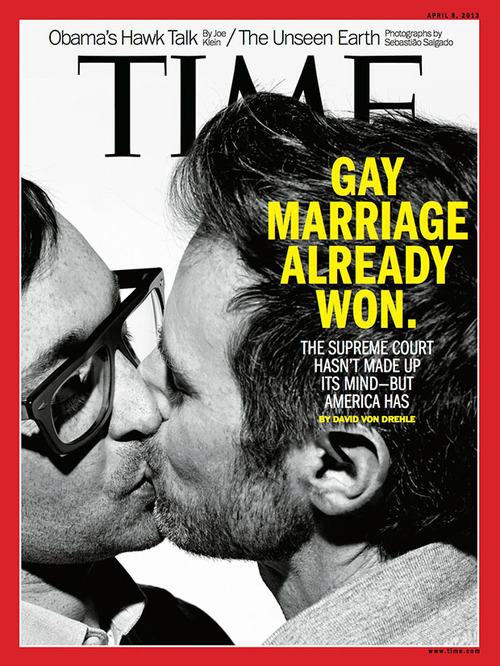
America has made its mind on gay marriage, TIME declares. In line with democratic thinking, the majority has spoken and their voices have said that gay Americans are accepted, gay activities are acceptable, and gay marriage should be legalized. But in only considering these Americans who have voiced these viewpoints, we have an inherent problem since support for and opposition against gay marriage are deeply entrenched, diametrically opposed viewpoints. By allowing just one of these voices to speak for the whole, TIME is implicitly defining America as the Northeast and Pacific (the most gay-friendly regions) or Americans as a college-educated, White populace (the most gay-friendly socioeconomic status).
Passing by this cover, I see my own viewpoints staring back at me. I immediately accept its declaration that America has aligned with gay marriage precisely because it is advertised for my demographic: wealthy, college-educated, coastal, White Americans. In the case of gay marriage support, there is a clear overlap between those that are in the mainstream and those that support gay marriage, thus supporting gay marriage—as proven by its presence on the cover of TIME magazine—has become a mainstream idea. Through the existence of this cover, a clear concept about the mainstream is illustrated: being in the mainstream means not only having your voice and opinions reflected on national media, but not even being aware of the dialogue that is happening outside of it—dialogue I am kept separate from due to color lines, income disparities, and sheer regional location. My opinions on these issues are shaped largely by television coverage and media like TIME, thus in showing this viewpoint, TIME is defying other’s voices, but also more significantly—given its dominance as one of the most widely read American magazines in the world—through making such declarations of widespread support, makes it appear that other voices and opinions do not even exist, which harms those with dissenting opinions by condoning and perpetuating only one acceptable stance on this issue within the American culture cycle.
“Gay Marriage Already Won.”
The fight over the right of gay couples to marry has been decided, according to the cover of TIME Magazine [1]. “Won” suggests a definitive end to the issue, a concept further emphasized with the period at the end of the title, transforming a mere opinion and title to an entire sentence—presented curtly and thus making a clear statement. Winning and success are concepts embodied by American readership, so using this word versus other options which would perhaps be more accurate (“decided,” “supported,” etc. given that no ruling has passed) appeals to this American desire for victory and achievement. The choice of the word “won” is particularly interesting since the subtitle even claims that legally the issue is not “won,” thus the definitive word suggesting final victory is actually false because the courts and legal action still have a battle ahead of them—as conceded by TIME itself. The subtitle also uses other terms that appeal to Americans, primarily using a form of the expression “made up its mind” which suggests the existence of not only choices but autonomy to select between them—concepts that are at the core of America’s deliberative democratic ideology. This means that Americans are in a way in control of deciding this issue—even though the subtitle concedes that they are not, since the laws ultimately decide.
Yet despite all of these terms that appeal to Americans and are expressive of European-American ideals of success, the message itself relays a disregard for a large swath of the population. While public support for gay marriage is in the majority now, the decision to say that America has made up its mind is controversial given that, though America’s majority supports it, making up one’s mind implies that the entity has agreed to a viewpoint or accepted a certain stance, which the entirety of America has not [2]. Democratically, gay marriage would be more supported than a ban on it would be at the national level, but there would be significant conflict with the opposition group. Examining the readership of TIME and the demographics behind the supporters of gay marriage show a clear relationship and overlap between the two populations which perhaps explains why the magazine chose these elements that imply, despite evidence to the contrary, the universality of the support of gay marriage.
TIME’s Readership and Gay Marriage’s Base
Looking at TIME Magazine’s audience, we see that over 70 percent attended or graduated college and that 32 percent of its readership falls within the top quintile of household incomes [3]. Additionally, TIME’s readership surpasses the national median household income by over 20,000 U.S. dollars [4]. Examining just these two numbers shows that TIME’s readership is clearly wealthier and more highly educated than the population as a whole. This population is the one that most fits into the mainstream of America, a mainstream that can be defined largely by whether or not one attends college given that universities espouse upper middle-class principles and being able to attend and complete college strongly correlates with wealth and Whiteness—both of which are standards reflected in mainstream advertisements and media as significant to the definition of American.
But just as TIME’s readership is not reflective of the entirety of America, neither is the population that supports gay marriage, also wealthier and more educated than the nation as a whole. In Pew studies on the support of gay marriage using data from the summer of 2012, one of the most stark differences in support for gay marriage came from the data concerning one’s level of education, which shows that the more educated one is, the more likely one is to support gay marriage. Only 38 percent of Americans with just a high school degree supported gay marriage, compared to 51 percent of those who attended some college and 60 percent of those with at least one college degree [5]. A similar trend can be seen in income, with those making over 75,000 dollars a year 12 percentage points more likely to support gay marriage than people who make less than 30,000 USD a year. These statistics correlate strongly with TIME’s readership, given that 70 percent attended some college and half of its readers make more than 72,000 dollars a year.
I posit that this correlation between readership and gay marriage supporters is precisely why TIME chose to use this cover and diction. The topic of gay marriage has long been controversial and, though supported by a majority of Americans now, remains highly contested and is strongly opposed by a large portion of Americans. TIME, however, did not fear significant, majority backlash from its readers perhaps precisely because they are aware that their readers (mostly being college-educated and upper middle class) reflect the attitudes of the mainstream. Thus in order to appeal to its readership, TIME must espouse and validate mainstream ideas, which, at the time of this cover’s release in April 2013, included condoning and encouraging America’s support for gay marriage.
Beyond Socioeconomic Status
Support for gay marriage is very much not uniformly distributed across the nation’s regions, with support for gay marriage highest in the Pacific and Northeast. New England has the highest support in the nation, with over 62 percent of its inhabitants favoring “allowing gays and lesbians to marry legally,” but the region defined as “South Central” only has 35 percent of its residents agreeing with this claim [6]. In 2012, the majority of the nation as a whole did not support gay marriage, however, four regions (New England, the mid-Atlantic, the Pacific Coast, and Mountain West) had support in the majority. This regional variability is significant, in that the East and West coasts hold different values than do southern and middle America, thus in supporting a viewpoint held by only half of the United States, TIME is implicitly suggesting which regions matter more to the definition of America.
But beyond economic differences between their readership and the average American, TIME makes additional assumptions about who is reading their magazine. By depicting a couple in which both members appear White on the cover of its magazine, TIME is failing to address the diversity of the population. There were two versions of this cover—one with two males kissing and another with two females kissing—and all of those four people appear White, even though the nation is only 77.9 percent White. It is notable that the other two photos in the photographer’s series which were not featured on the cover were of two black women kissing and an interracial couple with one Hispanic man [7].
Symbolic representation of racial minorities is psychologically significant given that by depicting White people on the cover of a publication that is arguably the most significant magazine in the United States suggests that the significant American cultural institution that is TIME is not inclusive of minorities. Additionally, TIME uses the word American on the cover, thus that word will implicitly be associated with the image—again reinforcing the idea held by the predominantly White mainstream that American means White.
Inside the Mainstream
For readers like me, this cover matches the America I live—one in which TIME’s statements and images correspond to my own community. My community is by a slim majority predominantly White, very highly educated, and during the 2008 election sported thousands of “No on Prop 8” stickers in an effort to help reject the proposed ban on same sex marriages in California following their legalization a year earlier. The couple on this cover could be me and the message it espouses is precisely what I would believe about America just from taking a look at the narrow sample that is my hometown of Irvine, California—namely that gay marriage has won.
Yet, my blissful acceptance of this cover and the blissful ignorance required to blindly accept it reflect the fact that the mainstream, despite being pervasive and imposed on everyone, goes unnoticed by those within it. Haney Lopez describes this phenomenon in the context of racial categorization, saying that “the race of non-Whites is readily apparent and regularly noted, while the race of Whites is consistently overlooked and scarcely ever mentioned” [8]. The mainstream is defined largely by what it is not, much as White has traditionally been defined not by positively defining White, but by rejecting individuals and defining who is not White. Thus, White Americans—and more generally any Americans that meet a sufficient subset of mainstream qualifications—are often unaware of the privileges that come with having the same viewpoints, skin color, family background, etc. that mainstream institutions espouse because they have not formed schemas to notice these differences as minorities are forced to do due to facing a lifetime of exclusionary practices. Mainstream individuals support these institutions precisely because these institutions cater to them, thus for many Americans like myself, TIME magazine’s cover is not only not rejecting my viewpoints, rather is very much supportive of my own thoughts.
If TIME speaks on behalf of Americans, then gay marriage truly has won in this nation, despite the fact that entire regions of the U.S. fiercely oppose it. But more broadly, if TIME speaks on behalf of Americans, then we are a nation that is college-educated, wealthy, White, and favoring the cultures of the coastal regions that accept gay marriage. This is where this cover becomes problematic. I have highlighted how it presents a narrow lens of who is American by appealing to a base that is narrow, but more alarmingly it suggests and reinforces definitions of belonging through excluding wide swaths of the population.
TIME magazine is an institution that produces man-made, weekly artifacts (each issue) imbued with cultural meaning with which individuals interact everyday. These interactions with “mundane cultural products” ultimately “make some ways to think, feel, and act easier than others” (Markus). Thus, images on the cover of TIME of White people kissing subconsciously imply Whiteness of Americans or the prevalence of support for gay marriage—turning away those that do not match or agree with these ideas. The key part of the idea of the culture cycle is that each of these one-way interactions fuel the reverse interaction as well since “your culture shapes your I so that you think, feel, and act in ways that perpetuate this culture” [9]. Through this process, people who hold dissenting opinions begin to find their own opinions invalid or feel Other-ed and unwanted by the system—often conforming to mainstream viewpoints accidentally through repeated exposure or begrudgingly (yet consciously) to gain some acceptance. Thus TIME is not only hurting dissenting individuals—by making their opinions appear unwanted or rejecting their sense of self from belonging to the traditional idea of American—but also forcing these individuals to unwillingly perpetuate these ideas, quieting their voices further and further dividing marginalized groups from the mainstream channels through which dialogue can occur.
References
[1] Hapak, Peter. TIME Magazine April 8, 2013 Cover. 2013. Photograph. TIME Magazine. N.p.: n.p., n.d. N. pag. Print.
[2] ”Gay Marriage: Key Data Points from Pew Research." Pew Research Center RSS. Pew, n.d. Web. 09 Mar. 2014.
[3] “TIME Media Kit - U.S. Audience." TIME Media Kit. TIME, n.d. Web. 09 Mar. 2014.
[4] “USA QuickFacts from the US Census Bureau." USA QuickFacts from the US Census Bureau. United States Census Bureau, n.d. Web. 10 Mar. 2014.
[5] “Two-Thirds of Democrats Now Support Gay Marriage." Pew Research Centers Religion Public Life Project RSS. Pew, n.d. Web. 10 Mar. 2014.
[6] “Behind Gay Marriage Momentum, Regional Gaps Persist." Pew Research Center for the People and the Press RSS. Pew, n.d. Web. 10 Mar. 2014.
[7] Pickert, Kate. "Behind the Covers: Portraits of the Gay Marriage Revolution by Peter Hapak." LightBox. TIME, 28 Mar. 2013. Web 10 Mar. 2014.
[8] López, Ian H. "White Lines." White by Law: The Legal Construction of Race. N.p.: New York UP, n.d. 1-26. Print.
[9] Markus, Hazel Rose., and Alana Conner. Clash!: 8 Cultural Conflicts That Make Us Who We Are. N.p.: Hudson Street, n.d. Print.
